Smooth vs textured PEI build plates: which one belongs on your printer
Quick answer
Textured PEI is the safer default plate for most printers, especially anyone printing PETG, such as the PEO side of a double-sided sheet like the YOOPAI PEI plus PEO plate at $17.99, because PETG bonds chemically to bare PEI and can tear a smooth sheet during removal. Reach for a smooth PEI plate, like the HENYCEE PEI build plate at $16.99, only when you want a glossy, flat-bottomed finish on PLA or ABS and know you will not be running PETG on it.
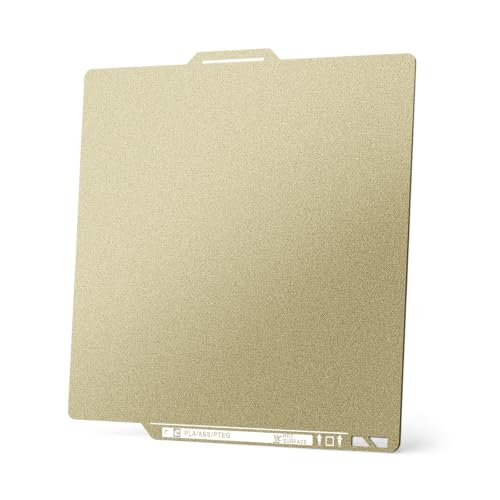
HENYCEE PEI Build Plate for Bambu Lab X2D/P2S/X1/X1C/X1E/P1P/P1S/A1
PLA and ABS prints where a glossy, flat-bottomed finish and maximum bed grip matter more than easy release
| Smooth PEI | Textured PEI | |
|---|---|---|
| Bottom surface finish | Glossy and flat | Matte, shows the plate's texture |
| Bed grip | Stronger, holds small or warpy parts down harder | Lighter, releases more easily once the plate cools |
| Typical release method | Often needs to cool fully or be flexed to pop free | Frequently releases on its own as it cools |
| PETG compatibility | Risky bare, PETG bonds chemically and can tear the sheet | Safer, the texture reduces the contact area PETG can grab |
| Glue stick or adhesive on PETG | Sometimes tried, but a glue stick only acts as a release agent, not an adhesive | Rarely needed for normal adhesion |
| Swapping between sheets | Requires re-leveling, plate thickness differs between sheets | Requires re-leveling, plate thickness differs between sheets |
What is the actual difference between smooth and textured PEI?
Smooth PEI is a flat, polished sheet that presses directly against the bottom layer of a print, which is why parts printed on it come out with a glossy, mirror-like bottom surface. Textured PEI has a fine surface pattern baked or coated into it, so the bottom layer of the print picks up that texture instead, giving a matte finish. The texture also reduces how much surface area actually contacts the print, which is the main reason textured plates tend to let a finished print pop free without much effort.
Why does PETG tear a smooth PEI sheet?
PETG does not just sit on top of bare PEI the way PLA does, it bonds to it chemically as it cools. On a smooth sheet that bond can be strong enough that trying to pry a part off actually lifts and tears the PEI coating itself, ruining the plate rather than just releasing the print. A common workaround is running a layer of glue stick on the plate first, but it is worth being clear about what that glue stick is doing: on PETG it works purely as a release agent, keeping the plastic from bonding directly to the PEI, not as an adhesive helping the print stick.
Do I need to re-level after switching build plates?
Yes, every time. Different PEI sheets are not always the same thickness, and that difference is enough to change the actual gap between the nozzle and the bed at the first layer even if your printer's stored level offsets stay the same. Swapping from a smooth sheet to a textured one, or between two different brands, means re-checking the first layer squish before trusting a print to come out clean.
Which plate should you default to if you only own one?
Textured, for most people. It handles PETG safely, releases the majority of prints without a fight, and still gives acceptable results on PLA and ABS even though the bottom surface will show the texture rather than coming out glossy. Smooth PEI is worth adding as a second plate specifically for PLA or ABS parts where a glossy finish or extra grip on a small, detail-heavy part is worth the extra effort getting the print back off.
Textured PEI plate

YOOPAI Double-Sided PEI + PEO Sheet and Flexible Magnetic Build Plate, 235x235mm 3D Printer Bed Platform for Creality Ender 3 V3 SE/KE /K1/K1C/ Ender 3/Ender 3 V3/3 Pro/ 5 S1/ 3 S1 Pro/3 Neo
PETG and general use, where a matte finish and easy release outweigh a smooth sheet's tear risk
Both sides of this comparison
- Geeetech
Geeetech 6-Pack 3D Printer Glue Sticks, 36g, Enhanced First Layer Adhesion
$11.99 Check pricePrices change often - HENYCEE
HENYCEE PEI Build Plate for Bambu Lab X2D/P2S/X1/X1C/X1E/P1P/P1S/A1
$16.99 Check pricePrices change often


Safety
Common questions
Does a glue stick help PETG stick to a PEI plate?
No, on PETG a glue stick works as a release agent rather than an adhesive. PETG already bonds chemically to bare PEI, sometimes too well, so the glue stick layer is there to keep the print from tearing the sheet on removal, not to add grip that PETG does not need in the first place.
Why did my print pop off the bed before it finished?
A textured plate that has cooled too far during a pause, or a bed temperature set too low for the material, can release a part early. Textured PEI is designed to let go once cool, which is normally an advantage, but it means bed temperature and any print pauses matter more than they would on a smooth, higher-grip plate.
Can I put a textured PEI sheet on any printer?
Only if it matches your printer's mounting system and bed dimensions, typically a magnetic base of the correct size. Check both before buying a replacement plate, since a sheet built for one printer's bed will not necessarily fit or attach securely to another.
Do I really need to re-level every time I swap plates?
Yes. PEI sheets vary enough in thickness between brands and even between smooth and textured versions of the same product line that the actual first layer gap changes when you swap. Skipping that check risks either a print that will not stick or one that gets crushed too flat against the bed.
Is smooth or textured better for small, detailed miniatures?
Smooth generally, since its stronger grip helps a small part's footprint stay put during the fiddly first few layers, and the glossy bottom finish looks cleaner on display pieces. That advantage only holds for PLA or ABS, since PETG on a smooth sheet risks tearing the plate rather than just releasing the part.