Best carbon fibre filament
Quick answer
FLASHFORGE Carbon Fiber PETG ($20.79, $20.79 per kilogram) is a reasonable first carbon fibre spool for stiffer, lighter parts than plain PETG. Every carbon fibre spool needs a hardened nozzle, not the stock brass one, since the fibres are abrasive enough to wear a brass orifice out of tolerance within a few hundred grams.

FLASHFORGE Carbon Fiber PETG Filament 1.75mm Black, Reinforced 3D Printer Filament 1kg, Lightweight & High-Strength PETG-CF Filament, Strong & Easy to Print
This spool's listing states strong layer adhesion and easy printing, which matters more with a filled filament than with plain PETG, where fibres can weaken layer bonding if the base material is not tuned for it.
The three tiers
Beginner: Best first carbon fibre spool
someone who already prints PETG comfortably and wants stiffer, lighter parts without switching materials entirelyThis spool is carbon-fibre-reinforced PETG, so print temperature and bed adhesion stay close to plain PETG settings, which shortens the learning curve. Carbon fibre reinforcement adds stiffness and reduces warping compared to plain PETG, at the cost of a rougher surface finish since the chopped fibres are visible at the surface layer.
Not for: anyone still printing on a stock brass nozzle; the fibres in this filament will wear a brass nozzle's orifice out of round within a few hundred grams, changing extrusion width mid-project
Intermediate: Best value
a printer who wants the same carbon-fibre-PETG properties at a similar price from a different brand- Intermediate pick
SUNLU Carbon Fiber PETG 3D Printer Filament, 1KG Matte Black PETG-CF
$20.89 Check pricePrices change often

SUNLU's carbon fibre PETG is priced at $20.89 per kilogram, within a few cents of the FLASHFORGE spool above, and is described as matte black, which tends to hide the visible fibre texture on the surface better than a glossy finish. It is a like-for-like alternative for anyone who prefers this brand or cannot source the other.
Not for: anyone who has not yet installed a hardened nozzle; the abrasiveness is a property of the carbon fibre itself, not the brand, so switching spools does not remove the need for hardened hardware
Expert: Performance ceiling for outdoor structural parts
someone printing brackets or fixtures that need both the stiffness of carbon fibre reinforcement and the UV resistance of ASA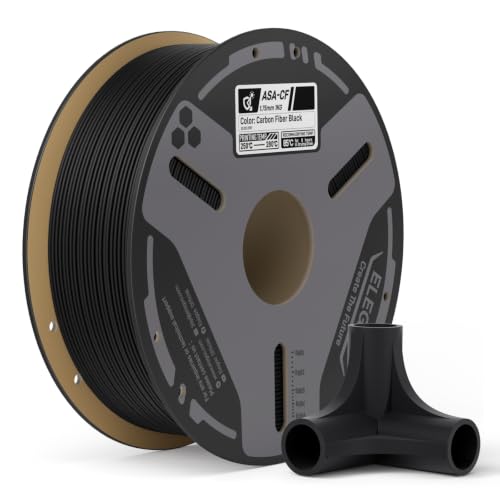
This spool combines carbon fibre reinforcement with an ASA base rather than PETG, so the listing states low warp, UV and weather resistance and high rigidity, useful for a bracket or mounting fixture that lives outside and also needs to resist bending. ASA already needs an enclosure on its own merits; adding carbon fibre on top raises the printing difficulty further.
Not for: a beginner to either carbon fibre filament or ASA individually. Do not start here: learn plain ASA's enclosure and bed adhesion requirements first, and learn carbon fibre's nozzle and surface-finish quirks with an easier PETG-CF spool, before combining both in one material.
| Spool | Base material | Price | Price per kg | Best for |
|---|---|---|---|---|
| FLASHFORGE Carbon Fiber PETG 1 kg | PETG-CF | $20.79 | $20.79 | First carbon fibre spool |
| SUNLU Carbon Fiber PETG 1 kg | PETG-CF | $20.89 | $20.89 | Matte finish alternative |
| ELEGOO Carbon Fiber ASA 1 kg | ASA-CF | $22.76 | $22.76 | Outdoor structural parts |
Why does carbon fibre filament destroy a brass nozzle?
A standard nozzle is machined from brass because brass is easy to shape precisely and conducts heat well, but it is also a comparatively soft metal. Carbon fibre filament is loaded with short, stiff, abrasive fibre fragments that act like sandpaper being pushed through the nozzle orifice with every print. Over a few hundred grams of filament, that abrasion wears the orifice wider and less round, which shows up as inconsistent extrusion width and, eventually, visibly worse print quality even at settings that used to work.
A hardened steel nozzle resists that same abrasion for far longer, which is why every carbon fibre spool should be treated as a two-part purchase: the filament itself, and a hardened nozzle installed before the first print.
Is carbon fibre PETG or carbon fibre ASA the better choice?
PETG-CF is the easier introduction to filled filament since it keeps PETG's more forgiving bed adhesion and enclosure requirements. ASA-CF adds UV and weather resistance on top of the same stiffness benefit, which matters for a part that will live outdoors, but it stacks ASA's own enclosure and ventilation requirements on top of carbon fibre's nozzle requirement, making it a combination best attempted after some experience with each material separately.
What projects actually benefit from carbon fibre filament?
Carbon fibre reinforcement earns its cost on parts that need to resist bending or sagging under their own weight or a mounted load, drone frames, camera mounts, jigs and fixtures, and brackets that span a distance without support. For a small, fully supported bracket or a purely decorative print, plain PETG or ASA gives similar real-world results for a lower price and without the nozzle wear.
How we chose
This roundup is researched from catalog listings and manufacturer-published specifications, not from in-person testing. Every product named is checked against PrintFarmCalc's own catalog of verified Amazon listings, and every price-per-kilogram figure is calculated from the listed pack weight and price.
Carbon fibre filament is graded here on how much it changes the printing process compared to its unfilled base material, PETG or ASA, since the fibre reinforcement itself is the variable that adds difficulty and hardware requirements, not the base plastic.
Buying tips
Do I need a hardened nozzle for carbon fibre filament?
Yes, without exception. The chopped carbon fibres in this filament are abrasive enough to wear away a standard brass nozzle's orifice within a few hundred grams of printing, gradually widening it out of tolerance and causing over-extrusion. A hardened steel nozzle resists that wear and is a mandatory purchase alongside any carbon fibre spool, not an optional upgrade.
Does carbon fibre filament make parts stronger?
It makes parts stiffer and more dimensionally stable, which is not the same as stronger against sudden impact. Carbon fibre reinforcement resists bending and warping better than the unfilled base material, but the chopped fibres can create small weak points at layer lines, so a carbon-fibre part can be more brittle under a sharp impact than the plain plastic it is based on.
Why does the surface finish look rough on carbon fibre prints?
The chopped fibres sit at the surface of the extruded strand and show through as a matte, slightly textured finish rather than the smooth surface of unfilled filament. This is a property of the material, not a print setting mistake, though a matte black color, as in the SUNLU spool compared here, tends to hide the texture better than lighter colors.
Should I upgrade my hotend as well as the nozzle?
A hardened nozzle is the mandatory first step. Some printers also benefit from a hardened or steel-lined heat break if carbon fibre becomes a regular material, since the fibres can wear softer internal components over time, but the nozzle is the part that fails first and fastest, and is the one upgrade that should never be skipped.
Other options worth knowing about
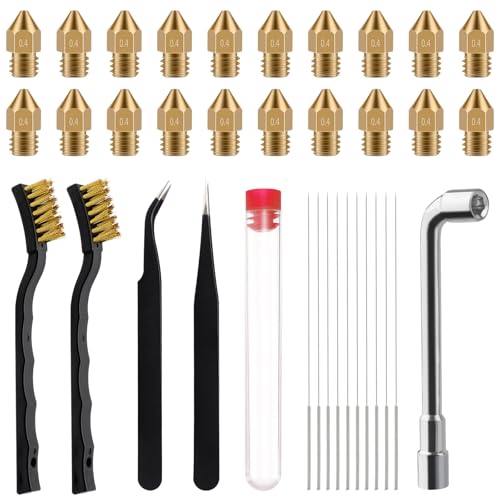
- LKNNEASTO
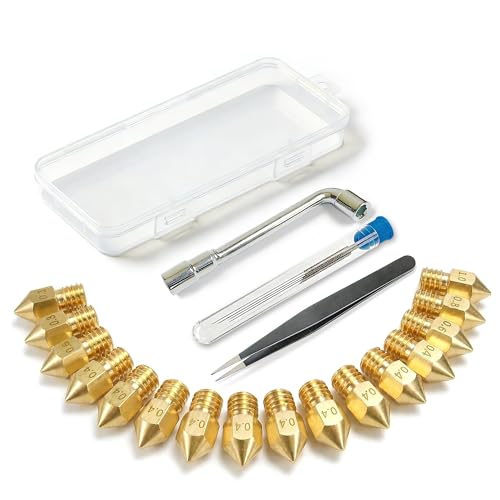
3D Printer Nozzle Kit, 16PCS MK8 Brass Nozzles 0.2/0.4/0.6/0.8/1.0mm
$7.19 Check pricePrices change often - Mudder
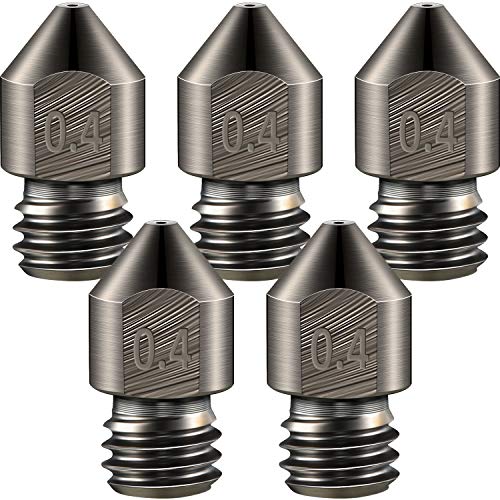
Mudder 5 Pcs Hardened Steel Nozzles 0.4mm Mk8 3D Printer Nozzles
$8.49 Check pricePrices change often - XIFOWE
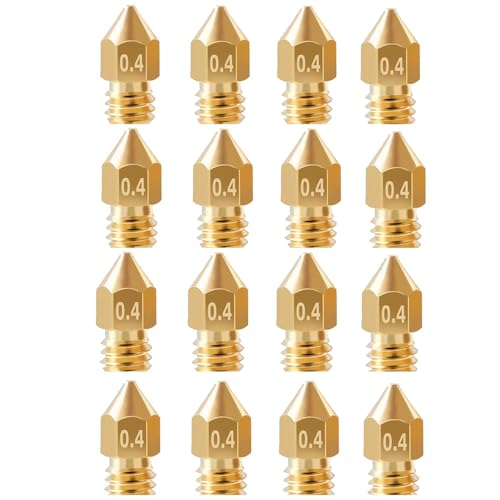
XIFOWE MK8 Nozzles 25 pcs 0.4mm 3D Printer Extruders Brass Nozzles
$9.99 Check pricePrices change often


Safety
Common questions
Can I print carbon fibre filament with a stock brass nozzle?
You can start a print, but you should not. Carbon fibre filament contains abrasive fibre fragments that wear a brass nozzle's orifice wider within a few hundred grams of printing, changing extrusion width and print quality partway through a project. Install a hardened steel nozzle before printing any carbon fibre filament; it is a required purchase, not an optional upgrade.
Does carbon fibre filament make a part stronger?
It makes a part stiffer and more resistant to bending and warping than the same unfilled plastic, which is often what "stronger" means for a functional bracket or fixture. It does not necessarily improve resistance to a sudden impact, since the chopped fibres can create small weak points at layer lines that make some carbon-fibre parts more brittle under a sharp hit.
Why does my carbon fibre print look rough or matte?
The short carbon fibres used to reinforce the filament sit at the surface of the printed strand, giving the finished part a textured, matte look rather than the smoother finish of unfilled plastic. This is normal for the material. A darker, matte-finished spool tends to hide the texture better visually than a lighter color, but the underlying texture is still there.
Should I choose carbon fibre PETG or carbon fibre ASA?
Choose PETG-CF for indoor structural parts and as a first carbon fibre filament, since it keeps PETG's simpler enclosure requirements. Choose ASA-CF for outdoor brackets or fixtures that need both stiffness and UV resistance, but expect a steeper learning curve since it combines ASA's enclosure and ventilation needs with carbon fibre's nozzle requirement.
How often do I need to replace a hardened nozzle used with carbon fibre?
A hardened steel nozzle resists carbon fibre's abrasiveness far longer than brass, often lasting through many kilograms of filled filament rather than a few hundred grams, but it is not immune to wear forever. Inspect the orifice periodically, and if a print that used to come out at the correct width starts running noticeably wider, that is the sign it is time to replace the nozzle.