Flow rate and maximum print speed
Quick answer
At 0.2 mm layers and 0.45 mm line width, a hotend rated at 20 mm3/s supports about 222 mm/s in PLA. Flow, not the motion system, is what limits most fast printing.
Flow equals layer height times line width times speed, which is geometry. Hotend maximum flow figures are manufacturer specifications, measured with PLA. The derating for other materials is a convention.
Your requested speed is inside the hotend limit, so the motion system is the constraint rather than the melt zone.
Manufacturer flow ratings are measured with PLA at a generous temperature. Treat them as a ceiling, not a cruising speed.
Hotends and nozzles
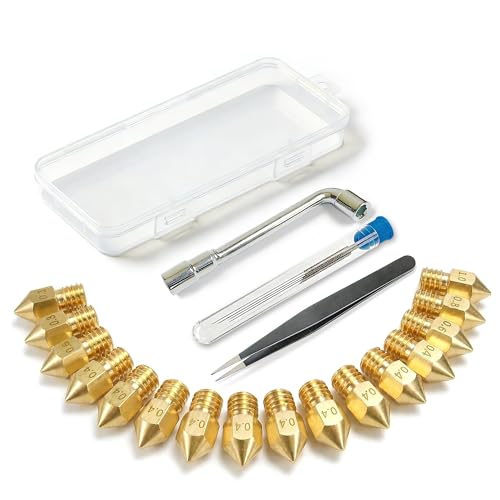
- LKNNEASTO
3D Printer Nozzle Kit, 16PCS MK8 Brass Nozzles 0.2/0.4/0.6/0.8/1.0mm
$7.19 Check pricePrices change often - Mudder
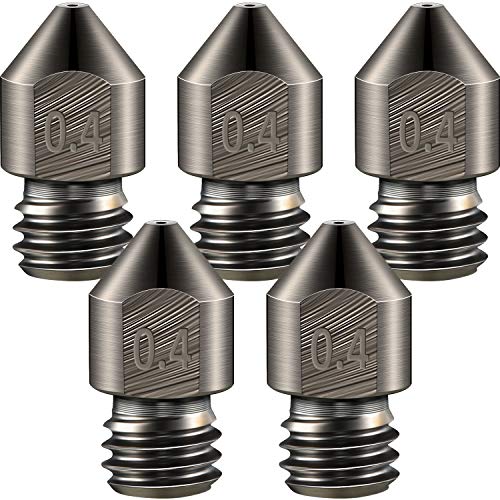
Mudder 5 Pcs Hardened Steel Nozzles 0.4mm Mk8 3D Printer Nozzles
$8.49 Check pricePrices change often - XIFOWE
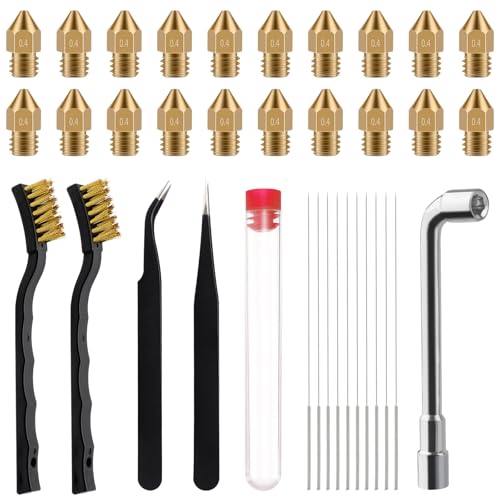
XIFOWE MK8 Nozzles 25 pcs 0.4mm 3D Printer Extruders Brass Nozzles
$9.99 Check pricePrices change often


Common questions
What is volumetric flow rate?
It is how much molten plastic the hotend can push out per second, measured in cubic millimetres per second. It is the real speed limit of a 3D printer, because the motion system can always move faster than the melt zone can melt. Every combination of layer height, line width and speed reduces to a single flow figure, which is what makes it useful for comparison.
How do I find my hotend maximum flow?
Manufacturers publish it for most modern hotends, and it is the figure this calculator uses. You can also measure it directly: extrude 100 mm of filament in mid air at increasing speeds and find the point where the extruder starts to skip or the extruded length falls short. That measured figure is more trustworthy than any specification.
Why does PETG print slower than PLA?
PETG needs more energy to reach a printable viscosity and it does not tolerate being rushed through the melt zone, so the usable flow is roughly three quarters of what the same hotend manages with PLA. TPU is far more extreme again, at roughly a third, because a flexible filament buckles in the feed path long before the melt zone is the limit.
My printer claims 600 mm/s. Can it do that?
It can move the head that fast, and on travel moves it will. Whether it can extrude at that speed is a different question entirely, and for most parts the answer is no. At 0.2 mm layers and 0.45 mm width, 600 mm/s demands 54 mm3/s, which only the largest high flow hotends approach and only with PLA.