Nozzle size to layer height limits
Quick answer
A 0.4 mm nozzle prints usable layers from 0.10 mm to 0.30 mm, with 0.20 mm as the everyday default. The convention is a layer height between a quarter and three quarters of the nozzle diameter.
The quarter to three quarters window is the standard community rule. The hard physical limit is that a layer taller than the nozzle orifice cannot be pressed into the layer below.
Nozzles
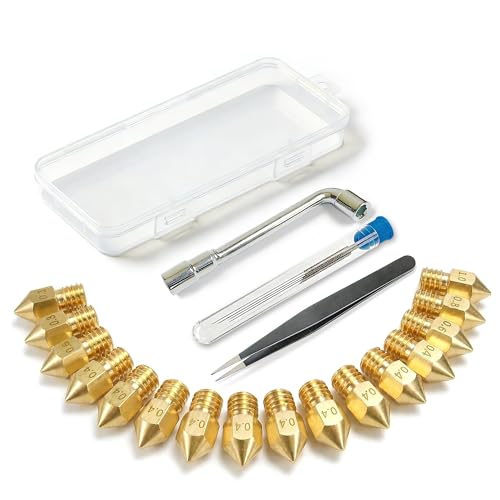
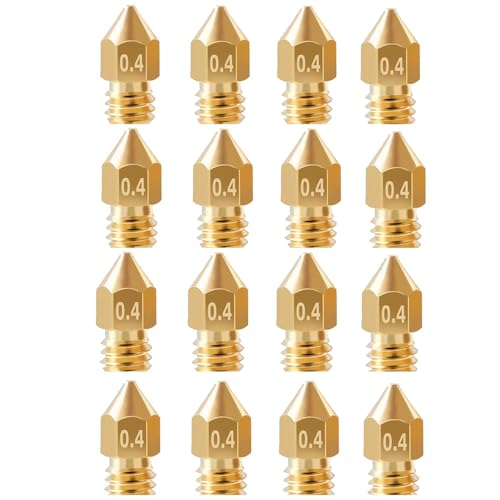
- LKNNEASTO
3D Printer Nozzle Kit, 16PCS MK8 Brass Nozzles 0.2/0.4/0.6/0.8/1.0mm
$7.19 Check pricePrices change often - Mudder
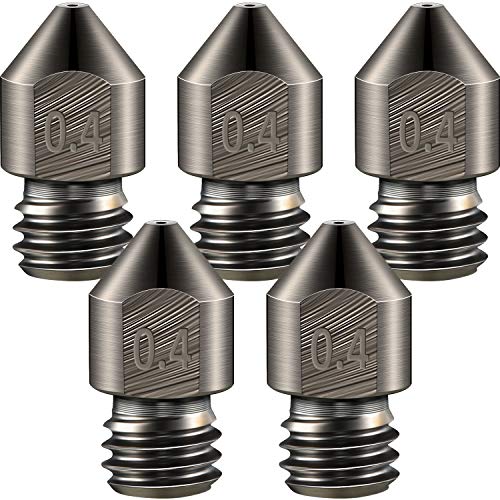
Mudder 5 Pcs Hardened Steel Nozzles 0.4mm Mk8 3D Printer Nozzles
$8.49 Check pricePrices change often - XIFOWE
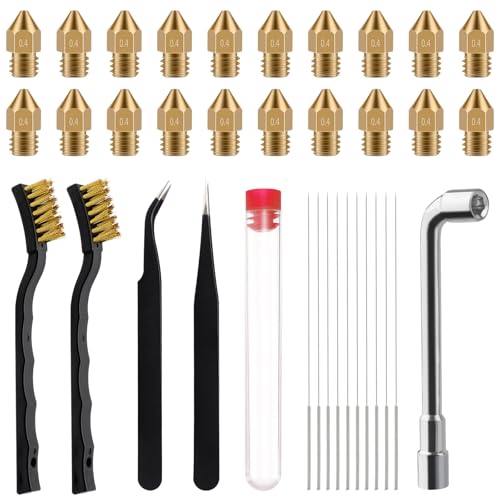
XIFOWE MK8 Nozzles 25 pcs 0.4mm 3D Printer Extruders Brass Nozzles
$9.99 Check pricePrices change often


Common questions
What layer height should I use with a 0.4 mm nozzle?
Use 0.2 mm for almost everything. It sits exactly in the middle of the usable range, it is what most printer profiles are tuned around, and it balances surface finish against print time well. Drop to 0.12 mm when a curved surface really matters, and go up to 0.28 mm for chunky functional parts where speed is worth more than finish.
Can I print finer detail with a smaller layer height?
Only in the vertical direction. Layer height controls how smooth curves and slopes look as they rise, but horizontal detail such as a thin wall, a small hole or a crisp corner is set by the nozzle diameter and line width instead. If your detail problem is in the XY plane, a smaller nozzle helps and a smaller layer height does not.
Is a bigger nozzle always faster?
It raises the ceiling but it does not guarantee the speed. A 0.6 mm nozzle lets you push a much thicker line, which is a large speed gain on solid parts, but only if the hotend can melt plastic fast enough to feed it. Check the required flow against your hotend limit before assuming the gain is real.
Why does my print look fine but snap easily?
A layer height too close to the nozzle diameter is a common cause. The surface can look perfectly acceptable while each layer is only lightly touching the one below, so the part has poor interlayer bonding and splits along a layer line under load. Dropping to half the nozzle diameter usually restores the strength.