Warping and lifting corners
Quick answer
ABS warping is usually an environment problem, drafts or a cold room, rather than a first-layer problem, so fix the environment before touching Z offset or bed temperature. Print ABS at a 100C bed and keep the surrounding air still and warm.
Bed temperatures are published material figures, while the emphasis on environment over first-layer settings reflects widely reported troubleshooting experience with ABS and ASA rather than a formal specification.
What does warping look like versus a simple adhesion failure?
Warping shows a distinct pattern that separates it from a plain sticking problem: a corner or edge that started out flat on the bed slowly curls upward as the print progresses, sometimes pulling free of the plate entirely while the center of the part stays put. It often gets worse the taller and larger the print gets, and it tends to show up specifically on parts with large flat bases or long straight edges rather than small or rounded ones.
A simple adhesion failure, by contrast, usually happens early, in the first few layers, and looks the same across the whole footprint of the part rather than concentrating at corners. If a print is several centimeters tall before a corner starts lifting, that is warping from internal stress, not a first layer that failed to bond.
Why does ABS warp so much more than PLA?
ABS shrinks noticeably as it cools from its print temperature down to room temperature, more than PLA does. That shrinkage happens unevenly across a large flat part: the outer edges cool and contract before the center does, and the resulting internal stress pulls the corners up and away from the bed. PLA shrinks much less on cooling, which is a large part of why it is far more forgiving to print without a heated enclosure.
ASA behaves similarly to ABS for the same underlying reason and needs the same environmental care. PETG sits in between: it shrinks less than ABS but is not entirely warp-proof on large parts, especially in a cold or drafty room.
Is this really an environment problem and not a first-layer problem?
For ABS and ASA specifically, yes, more often than not. A draught from an open window, an air conditioning vent, or even a door opening nearby cools one side of a print faster than the other, and that uneven cooling is what triggers the internal stress that lifts a corner. A cold room has the same effect across the entire print rather than just one side. Neither of these is fixed by adjusting Z offset or bed temperature, because the problem is happening well above the first layer, in air the printer has no control over unless something is done about it.
This is why chasing Z offset or adding more bed adhesive often fails to fix ABS warping: those fixes target a first-layer bonding problem, and warping caused by drafts is a cooling problem that happens layers later. Fix the environment first, then revisit first-layer settings only if warping still shows up afterward.
Could my bed temperature or plate still be part of the problem?
Bed temperature matters as a baseline even though it is not the primary fix. ABS needs roughly 100C at the bed for the first layer to hold well enough to resist the pull of a warping corner; printing meaningfully below that gives warping an easier win because the bond it has to overcome is weaker to begin with. A plate that is dirty from skin oils or worn at the surface makes the same problem worse for the same reason.
Once bed temperature and plate condition are both confirmed to be correct, any remaining warping on ABS or ASA points back to the surrounding air, not the plate.
How do I actually stop warping?
Start with the environment: close nearby windows and doors, move the printer away from air conditioning or heating vents, and if possible print in a room that stays reasonably warm rather than one that swings in temperature. A simple draft shield, even an enclosure without active heating, blocks moving air across the print and is often enough on its own for small to medium ABS parts.
From there, confirm bed temperature matches the material, 100C for ABS and ASA, and that the plate is clean. For large, flat ABS parts that still warp after the environment is controlled, reducing part size, adding a brim, or reorienting the print to reduce the size of any single flat face touching the bed all help, since the root cause is stress across a large flat area, and reducing that area reduces the stress.
Do I need an enclosure, and does it solve everything?
An enclosure that holds warmer, still air around the print is a genuine and often necessary fix for warping on ABS and ASA, especially in a cold or drafty room where opening a window is not practical. It addresses the actual cause: uneven cooling across the part.
It is worth knowing what an enclosure does not fix on its own. ABS and similar filaments release VOCs and ultrafine particles while printing, and an enclosure concentrates those fumes around the print rather than removing them. An enclosure needs extraction as well, not instead, venting or filtering the air rather than simply sealing it in with the print. Treat an enclosure as solving the warping problem and extraction as solving the air quality problem; one does not substitute for the other.
| Material | First-layer bed temp | Warping risk | Primary fix |
|---|---|---|---|
| PLA | 60C | Low | Rarely needs more than a clean plate |
| PETG | 80C | Low to moderate | Draft control on large flat parts |
| ABS | 100C | High | Stable, warm, draft-free air, plus correct bed temp |
| ASA | 100C | High | Same as ABS; outdoor UV resistance does not change print behavior |
Equipment mentioned here
- Geeetech
Geeetech 6-Pack 3D Printer Glue Sticks, 36g, Enhanced First Layer Adhesion
$11.99 Check pricePrices change often - HENYCEE
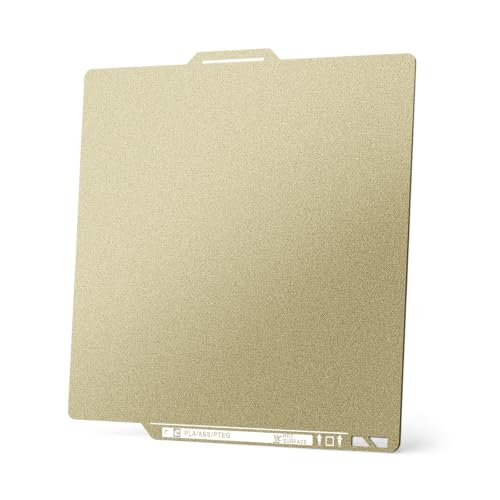
HENYCEE PEI Build Plate for Bambu Lab X2D/P2S/X1/X1C/X1E/P1P/P1S/A1
$16.99 Check pricePrices change often




Safety
Common questions
Why does my ABS print warp even though the bed is at the right temperature?
Bed temperature is necessary but usually not sufficient on its own. ABS warping is mostly driven by uneven cooling in the air around the print, from a draft or a cold room, rather than by what is happening at the plate. Check for nearby vents, open doors, or windows before assuming the bed setting itself is wrong.
Does a bigger brim fix warping?
A brim adds extra surface area holding the print down at the very edge, which can help resist a corner lifting, but it treats the symptom rather than the underlying cooling stress. On a print that warps badly, fixing the environment first and using a brim as extra insurance works better than relying on a brim alone.
Is an enclosure enough by itself to stop ABS warping?
An enclosure that keeps the air around the print warm and still is a genuine fix for warping. It is not a complete solution for air quality, though: ABS releases VOCs and ultrafine particles, and an enclosure concentrates them around the print rather than removing them, so extraction is still needed alongside it.
Why does warping only happen on my larger prints?
Warping is driven by internal stress from uneven cooling across a flat area, and that stress scales with the size of the part. A small ABS part may have too little flat area for the stress to overcome the bed bond, while a larger part with the same material and settings has enough surface area for a corner to actually lift.
Should I switch from ABS to PETG to avoid warping entirely?
PETG shrinks less than ABS on cooling and is generally easier to print without a controlled environment, so it is a reasonable substitute when ABS-specific properties, like higher heat resistance, are not required. It is not entirely immune to warping on large parts in a cold or drafty room, just less prone to it than ABS.