Laser fire safety
Quick answer
Never leave a running laser unattended, keep a fire extinguisher rated for the job, such as the Kidde Basic 110 1-A:10-B:C extinguisher ($19.97), within arm's reach of the machine, and treat card, paper and thin veneer as the fastest-igniting materials on the bed since small flare-ups start there first.
These are widely shared shop practices for desktop laser operation rather than a single formal fire code, and they assume the machine is otherwise set up and vented correctly.
Why can't I just walk away from a running laser?
A laser beam is an open ignition source working directly on flammable material for the entire length of a job. Small flare-ups, a brief flame that catches and self-extinguishes on a single pass, are common and mostly harmless when someone is watching, because they get noticed and dealt with in seconds. The same flare-up left unattended for even a few minutes on a longer job has time to spread past the point where blowing it out or dabbing it is still an option.
Jobs that run long enough to tempt someone away, batch engraving, a lengthy cut file, or a slow detailed pass, are exactly the jobs where an early flare-up has the most time to grow before anyone would notice if nobody is watching.
What fire extinguisher should I keep near a laser cutter?
Keep a dry chemical extinguisher rated for ordinary combustibles within arm's reach of the machine, not across the room or in another room entirely. A compact unit such as the Kidde Auto 5 5-B:C extinguisher ($17.88) or the Ougist ABC extinguisher ($31.67) is easy to mount near a desktop laser without taking up much bench space. The extinguisher only helps if it can be grabbed in the first few seconds of a flare-up, so placement matters as much as owning one at all.
Which materials catch fire fastest on a laser bed?
Card, paper and thin wood veneer ignite fastest of the common laser materials, since they are thin, low-mass and have a lot of exposed surface area relative to their thickness. A flare-up on these materials can go from a spark to a visible flame in seconds, faster than on a thicker solid piece of plywood or acrylic doing the same job. Extra attention during any job on thin paper-based or veneer stock is worth it precisely because these materials give the least warning before a flare-up becomes a real flame.
Does air assist make an unattended laser safe?
No. Air assist blowing across the beam path reduces how often a small flare-up catches and holds, because it disrupts the conditions a flame needs to sustain itself right at the cutting point. It does nothing once a fire has actually started and spread beyond the immediate cut line, and it cannot put out a flame that has caught on surrounding material rather than at the beam itself. Air assist is a risk reducer during normal operation, not a substitute for someone watching the machine.
Why is PVC and vinyl a fire and toxicity risk, not just a fume risk?
PVC and vinyl release chlorine gas when lasered, which is a health hazard on its own, but the same materials also tend to melt and drip rather than cut cleanly, which can deposit burning or smoldering material in places the beam did not intend. Most cheap faux leather and sign vinyl is PVC, and it should never be loaded onto a laser bed regardless of ventilation, ignition risk aside. The chlorine gas alone is reason enough, and it corrodes the machine's optics and rails over repeated exposure as well.
What else reduces fire risk beyond having an extinguisher?
Clearing off-cuts and dust from inside the enclosure before starting a job removes fuel that a flare-up could otherwise spread into, since scrap material and built-up dust ignite more easily than the intact workpiece. Keeping the bed area free of anything not directly part of the current job, and checking that the lens and mirrors are clean so the beam is cutting efficiently rather than wasting energy as scattered heat, both lower the odds of the kind of unexpected flare-up that catches an operator off guard.
| Extinguisher | Rating | Price |
|---|---|---|
| Kidde Auto 5 | 5-B:C | $17.88 |
| Kidde Basic 110 | 1-A:10-B:C | $19.97 |
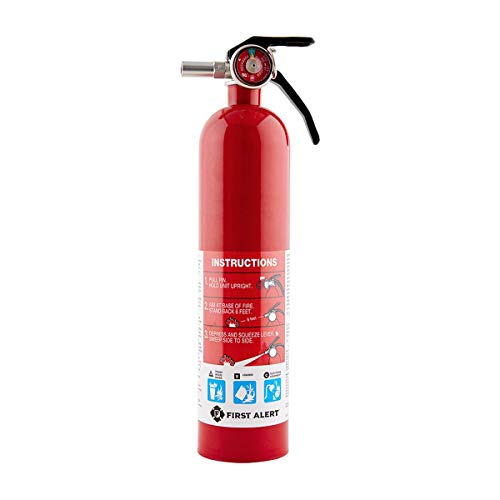
| First Alert Fire Extinguisher | Standard home use | $19.98 |
| Ougist ABC Fire Extinguisher | 1-A:10-B:C | $31.67 |
Equipment mentioned here
- Kidde
Kidde Auto 5 Fire Extinguisher for Cars and Trucks, 5-B:C, M5G
$17.88 Check pricePrices change often - Kidde
Kidde Basic 110 Fire Extinguisher for Home, 1-A:10-B:C, FA110G, 1 Pack
$19.97 Check pricePrices change often



Safety
Common questions
Is it ever okay to leave a laser cutter running unattended?
No. Even a job that has run without issue many times before can flare up on any given pass, and an unattended flare-up has far more time to spread before anyone notices. Stay within sight and hearing of a running laser for its entire job, including short jobs.
What kind of fire extinguisher works for a laser cutter fire?
A dry chemical extinguisher rated for ordinary combustibles, commonly labeled with a rating like 1-A:10-B:C, suits the wood, paper and plastic materials typically on a laser bed. Keep it mounted within arm's reach of the machine rather than stored elsewhere.
Why do paper and thin veneer catch fire faster than plywood on a laser?
Thin materials have more exposed surface area relative to their mass, so heat from a flare-up spreads through them and turns a spark into a visible flame much faster than it would on a thicker, denser piece of plywood or acrylic doing a similar job.
Does air assist prevent laser fires?
Air assist reduces how often small flare-ups catch and hold by disrupting the flame right at the cutting point, but it cannot stop a fire that has already spread past the beam path. It is a risk reducer, not a replacement for staying with the machine.
Can I laser vinyl or PVC if I have strong ventilation?
No. Ventilation manages fumes but does not remove the underlying hazard: PVC and vinyl release chlorine gas when lasered, which harms the operator and corrodes the machine's optics over time regardless of how well the fumes are extracted. Do not cut these materials at all.