Best large format 3D printers
Quick answer
The Creality Ender 3 V3 Plus ($374.99) is the best mid-range large format 3D printer: its listing states an 11.8 by 11.8 by 13.0 inch print volume with a 600mm/s-rated CoreXZ frame, larger and faster than a standard Ender at a moderate price step up.

Creality Ender 3 V3 Plus 3D Printer, CoreXZ 600mm/s High-Speed Auto Leveling Direct Drive Extruder Stable Metal Build Tri-Metal Nozzle Ender 3D Printer Large Print Size 11.8x11.8x13.0in
It states a larger 11.8 by 11.8 by 13.0 inch print volume directly in the listing, and pairs it with a CoreXZ frame rated for high-speed printing, without the price jump of the flagship K-series machines.
The three tiers
Beginner: Cheapest large-format entry
someone who wants a bigger bed than a standard entry-level printer without spending much more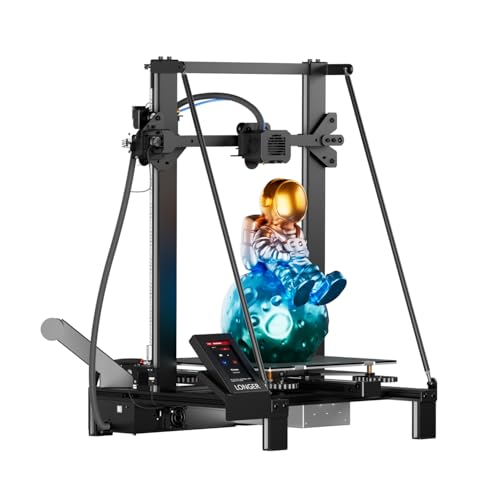
The Longer LK5 Pro 3 is sold with an 11.8 by 11.8 by 15.7 inch build volume, one of the tallest in this roundup, at $279.99. It arrives largely pre-assembled, which matters more on a large-format frame where more parts have to be aligned correctly than on a small printer.
Not for: buyers who want the fastest possible print speeds; large open frames like this one are more prone to ringing and vibration on tall, fast prints than a braced CoreXY design
Intermediate: Best value
a buyer who wants a bigger bed and more print speed without stepping up to a flagship machineThe Creality Ender 3 V3 Plus lists an 11.8 by 11.8 by 13.0 inch print volume on a CoreXZ frame rated for 600mm/s, at $374.99. That combination of stated build volume and stated speed rating makes it a clear step up from a standard Ender without the cost of a flagship large-format machine.
Not for: anyone printing objects taller than about 13 inches; check the exact print volume against your project before buying
Expert: Performance ceiling
a buyer who wants the largest, fastest printer in the Creality K-series lineup- Expert pick
Creality K1 Max 3D Printer, 600mm/s Max High-Speed with Dual Cooling
$549.00 Check pricePrices change often

The Creality K1 Max carries the "Max" designation that, across Creality's K-series, marks the larger-bed variant of the line, and its listing states a 600mm/s top speed with dual cooling. At $549.00, it is the highest-capability large-format machine in this roundup.
Not for: a first-time 3D printer owner. Do not buy a large-format flagship as your first machine: the bed size adds calibration surface area to keep flat and level, which is harder to troubleshoot without prior experience.
| Printer | Price | Brand | Stated build volume / speed | Best for |
|---|---|---|---|---|
| Longer LK5 Pro 3 | $279.99 | Longer | 11.8 x 11.8 x 15.7 in | Cheapest tall build volume |
| Creality Ender 3 V3 Plus | $374.99 | Creality | 11.8 x 11.8 x 13.0 in, 600mm/s CoreXZ | Best value with speed |
| Creality K1 Max | $549.00 | Creality | 600mm/s, dual cooling | Largest bed in the K-series line |
What counts as a large format 3D printer?
There is no single industry line, but printers in this roundup are included because their own listings state a print volume noticeably above a standard entry-level printer's roughly 8.6 inch cube, or because the brand markets them under a naming convention, like "Plus" or "Max", that it uses specifically to denote a bigger bed within its own lineup.
The practical test is simpler: if your project regularly hits the size limit of a standard printer, a large-format machine with a stated volume comfortably above that limit is worth the added cost.
Does a bigger bed mean slower prints?
Not necessarily. Filling more volume with plastic takes longer in raw terms, but several large-format printers, including the Ender 3 V3 Plus and the K1 Max in this roundup, pair the larger bed with a frame stated to support 600mm/s printing. A larger, faster machine can finish a big model in less added time than a large, slow one.
Is a large-format printer a good first 3D printer?
Generally no. A bigger bed is a bigger surface to keep level and adhered, which adds a variable a first-time owner has not yet learned to manage on a small printer. It is a reasonable second printer once basic bed leveling, filament handling and slicer settings are already familiar.
Do I need an enclosure with a large-format printer?
Only if printing ABS, ASA, or another material sensitive to drafts and temperature swings. A large open frame exposes more of the print to ambient air than a small one, which raises warping risk on tall prints in those materials specifically. For PLA and PETG, an open-frame large-format printer works fine in a normal indoor room.
How we chose
This roundup is researched from manufacturer listings and published specifications rather than in-person testing. Every dimension or speed figure quoted here comes directly from the product's own listing title or description, not from an estimate.
Products were included only when their listing explicitly states a larger-than-standard print volume, a speed rating, or a naming convention (such as "Max" or "Plus") that the brand itself uses to denote a bigger-bed variant within its lineup.
Buying tips
Check the stated print volume against your actual project
Large format is relative. Compare the exact print volume stated in the listing, not just the word "large," against the tallest, widest object you actually plan to print. A few inches of shortfall can rule out a specific project.
Bigger beds need better first-layer adhesion
A warped corner is a bigger problem on a large bed than a small one, because more surface area is exposed to drafts and uneven heating. Budget for a quality adhesive or PEI plate rather than relying on a bare glass bed for large prints.
Watch print time, not just build volume
A larger printer that also prints faster, as several in this roundup are rated to do, offsets some of the extra time that filling a bigger volume of plastic naturally takes. A large, slow printer can turn a big model into an overnight print that a faster large-format machine finishes in a few hours less.
Enclosures matter more at scale
A large open-frame printer exposes more surface area to room drafts than a small one, which increases warping risk on tall ABS or ASA prints specifically. If large-format printing in those materials is the goal, weigh an enclosed option or a add-on enclosure tent alongside the printer itself.
Other options worth knowing about
- Creality
Creality Ender 3 V3 SE Beginner-Friendly 3D Printer with Auto Leveling
$186.14 Check pricePrices change often - Creality
Creality Ender 3 V3 SE 3D Printer with Sprite Extruder
$219.00 Check pricePrices change often - Creality
Creality Ender 3 V3 SE 3D Printer Bundle with PLA Filament 4 Packs (Black+White+Red+Blue)
$225.95 Check pricePrices change often - BAMBULAB
Bambu Lab A1 mini 3D Printer + LED Lamp Kit, Ready-to-Use for Beginners
$249.00 Check pricePrices change often


Common questions
What is the cheapest large format 3D printer?
The Longer LK5 Pro 3, at $279.99, is the cheapest printer in this roundup with a stated large build volume, 11.8 by 11.8 by 15.7 inches according to its own listing. It arrives largely pre-assembled, which helps on a larger frame with more parts to align.
Is the Creality K1 Max bigger than the standard K1?
The "Max" name in Creality's K-series lineup denotes the larger-bed variant of that line, a naming convention Creality uses consistently across the series. The K1 Max also carries a stated 600mm/s top speed with dual cooling in its listing.
Does a large format printer need a bigger enclosure?
If you plan to print ABS or ASA on a large-format machine, yes, since a larger open frame exposes more surface area to room drafts than a small printer. For PLA and PETG, a large open-frame printer generally performs fine without an enclosure.
How much more does a large format printer cost than a standard one?
In this roundup, large-format options range from $279.99 to $549.00, roughly $90 to $360 more than a basic entry-level printer. The exact premium depends on whether the added size also comes with a faster frame or additional cooling.
Should a beginner buy a large format 3D printer first?
It is not the recommended starting point. A bigger bed is more surface area to keep level and adhered, which adds a variable a first-time owner has not yet learned to manage. Most people are better served learning on a standard-size printer first, then upgrading to large format once a specific project requires it.